Recent Advances in Inorganic Chemistry: Metal-Based Therapeutics, Functional Materials, and Biomedical Applications
Keywords:
- Inorganic chemistry; metal complexes; metal–organic frameworks; coordination chemistry; nanomaterials; MRI contrast agents; radiopharmaceuticals; biosensors; functional materials; biomedical applications
Abstract
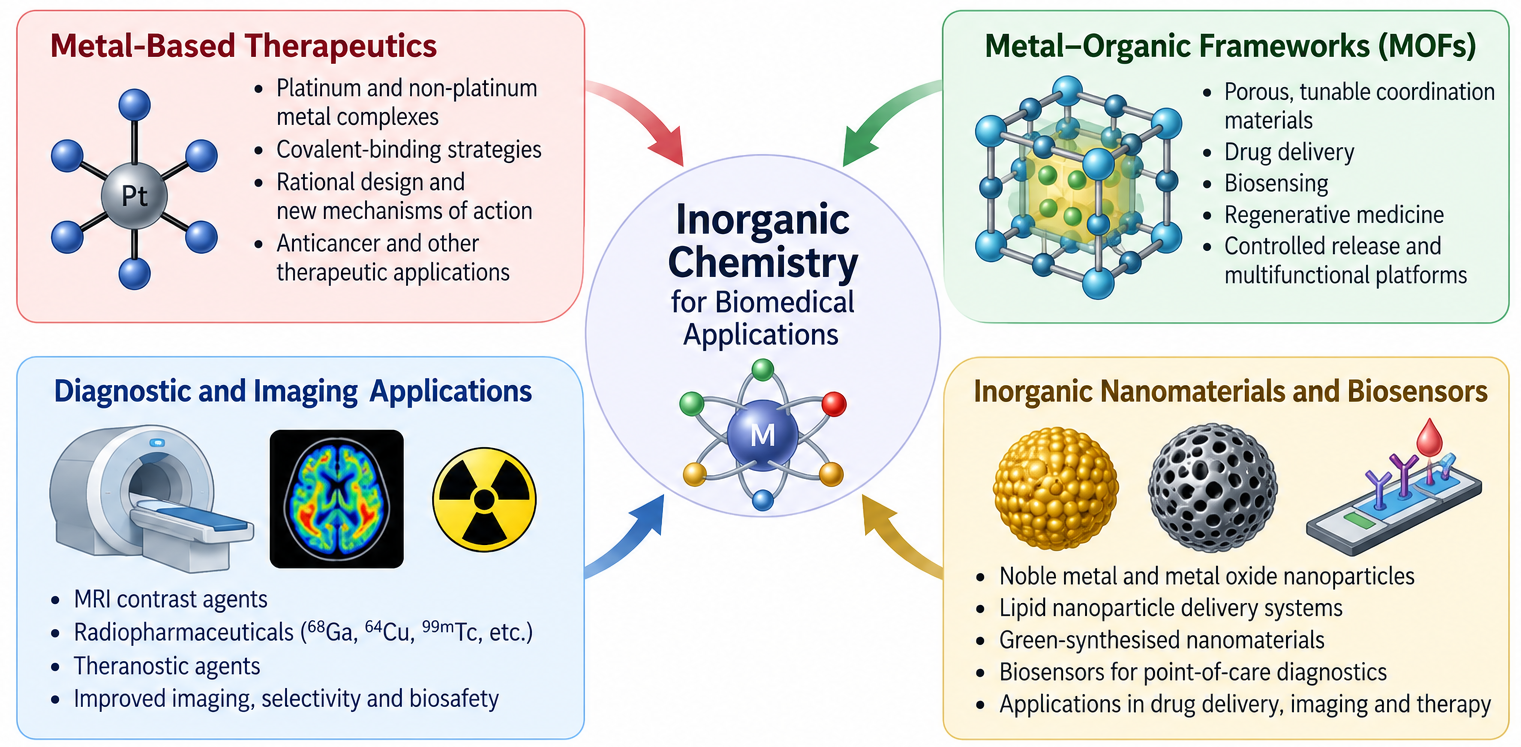
Inorganic chemistry continues to supply a distinctive and expanding toolkit for biomedical application, exploiting coordination geometry, redox activity, and nanoscale physical properties that are largely inaccessible to purely organic small molecules. This review surveys four convergent domains of contemporary biomedical inorganic chemistry. We first examine metal-based therapeutics, tracing the field's foundation in platinum coordination chemistry through to non-platinum complexes and the covalent-binding design principles that inform rational metallodrug optimisation. We then survey metal–organic frameworks (MOFs), porous, tunable coordination materials increasingly applied across drug delivery, biosensing, and regenerative medicine. We further examine diagnostic and imaging applications, spanning magnetic resonance imaging contrast agents and the coordination chemistry underlying modern radiopharmaceutical design, before surveying inorganic nanomaterials — noble metal and metal oxide nanoparticles, lipid nanoparticle delivery systems, and their green-synthesised variants — and the biosensor platforms built upon them for point-of-care diagnostic application. We then examine the growing integration of computational and artificial intelligence-guided methodology, together with established rational drug design principles including fragment-based design, bioisosterism, and covalent inhibitor engineering, into inorganic and metal-based drug discovery, and survey sustainable synthetic methodology increasingly applied to functional materials synthesis more broadly. Finally, we critically examine the translational challenges — including nanomaterial characterisation burden, biodistribution uncertainty, and the persistent gap between preclinical materials characterisation and clinical application — that continue to constrain this mechanistically diverse field, and outline priority directions for continued development. We conclude that biomedical inorganic chemistry, spanning metal complexes, functional coordination materials, and inorganic nanomaterials, represents a mechanistically distinct and continually expanding complement to organic small-molecule and biologic therapeutics.